Skip to main content Skip to footer
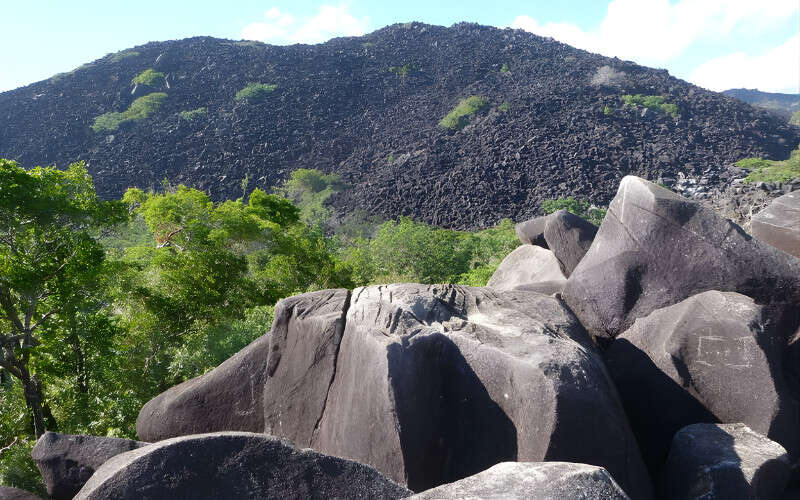
Most of the landscape between Cairns and Cooktown is green, with dense rainforest on the coastal route and open savannah on the inland highway. So when Black Mountain appears on the horizon, rising starkly from the surrounding scrub, it stops you cold.
There is nothing gradual about it. One moment you are driving through ordinary Far North Queensland bush, and then there it is – a mass of dark, bare boulders piled roughly 300 metres high, with no soil, no real vegetation, and no obvious explanation for why it looks the way it does. The contrast with everything around it is absolute.
It is called Kalkajaka by the Eastern Kuku Yalanji people, and it has been drawing curiosity, reverence, and wariness from both Indigenous Australians and European settlers for as long as anyone has recorded. Understanding why requires getting into the geology, the cultural history, and the stories that have accumulated around this place over centuries.
What is Black Mountain Cooktown?
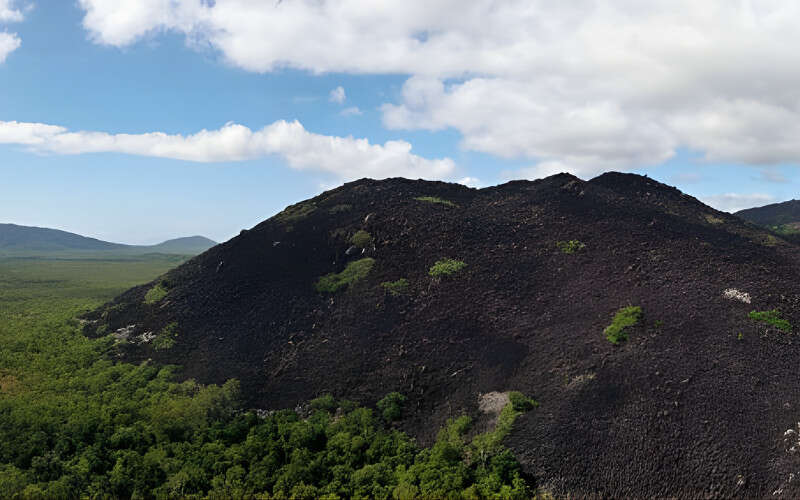
Black Mountain is a large granite boulder formation sitting approximately 25 kilometres south of Cooktown along the Mulligan Highway. It is protected within Kalkajaka National Park, a 781-hectare reserve managed jointly by Queensland Parks and Wildlife Service and the Eastern Kuku Yalanji traditional owners.
The mountain is not a peak in the conventional sense. It is an enormous accumulation of granite boulders, some the size of houses, stacked and interlocked with virtually no soil between them. The gaps and passages created between the rocks form a labyrinth of caves and chambers that runs deep into the mountain’s interior. Access beyond the viewing platform is not permitted, and for good reason.
What makes it visually striking is the colour. The boulders appear almost jet black against the surrounding landscape, a result of a thin film of microscopic algae growing on exposed surfaces. The underlying rock is actually a grey to white granodiorite. The darkness is a living skin on ancient stone.
Related reading: Things to Do in Cooktown
How did Black Mountain form?
Black Mountain’s structure is the result of geological processes that began around 260 million years ago.
Molten rock slowly solidified deep below the Earth’s surface, forming a large body of hard granite. Over millions of years, the softer material above eroded away, gradually exposing the fractured top of the granite mass. As the rectangular blocks were exposed, their corners became progressively weathered into the rounded boulders visible today. The absence of soil between them is what gives the mountain its hollow, labyrinthine character. Rainwater drains straight through rather than accumulating.
The boulder maze creates a microhabitat unlike anything else in the region, which is why the species that have adapted to it exist nowhere else on earth.
What lives on Black Mountain?
For a place that looks almost lifeless from a distance, the biodiversity at Black Mountain is remarkable.
The boulder formation supports three animal species found nowhere else in the world:
- The Black Mountain boulder frog (Cophixalus saxatilis) – a small rock-haunting frog adapted to life in the gaps between boulders
- The Black Mountain skink (Carlia scirtetis) – a lizard species endemic to this formation
- The Black Mountain gecko (Nactus galgajuga) – its scientific name is itself a form of the Aboriginal name for the mountain
- Ghost bats – the only truly carnivorous bat species in Australia, roosting in the dark interior and feeding on frogs, lizards, birds, and small mammals
- Giant amethystine pythons, carpet pythons, and northern death adders – all found among the rocks
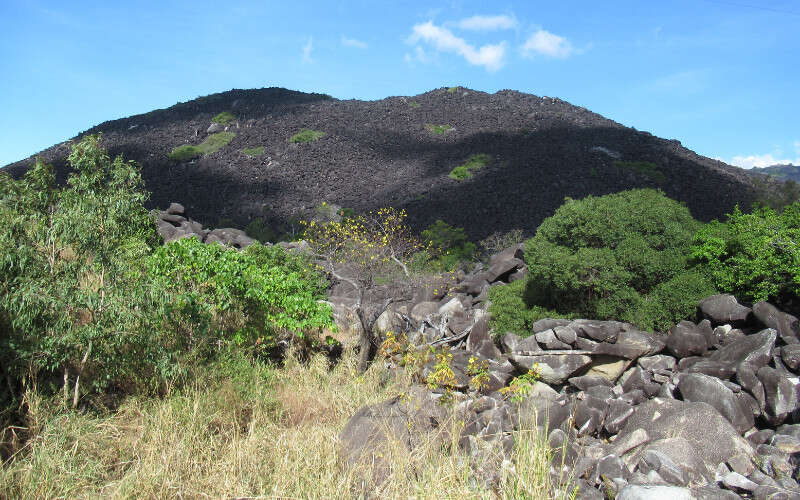
The green patches visible on the otherwise bare rock faces are large fig trees, their roots extending deep into fissures to draw water and nutrients from within the mountain. Around the base, rainforest plants – umbrella trees, ferns, and stinging trees – have adapted to conditions that have no business supporting them. As the Black Mountain National Park entry on Cooktown and Cape York describes it – a surprisingly rich ecosystem hiding beneath an apparently barren surface.
What is the Aboriginal significance of Kalkajaka?
Kalkajaka is a place of deep cultural and spiritual significance for the Eastern Kuku Yalanji people, who are its traditional custodians.
The name translates as “place of the spear” – a reference to its historical role as a site of ancient battles and its importance in Dreaming stories. One story tells of two giant brothers who throw enormous boulders at each other in a dispute, forming the mountain in the process. These are not decorative myths. They are the framework through which the landscape is understood and respected.
There are at least four named sites of religious and mythological significance within the park. Kambi is a large rock with a cave where flying-foxes are found. Julbanu is a kangaroo-shaped rock facing toward Cooktown. Birmba faces toward Helenvale. Yirrmbal, near the foot of the range, is a taboo place. Access to these sites is not permitted to the public, and climbing the mountain is strongly discouraged by traditional owner groups.
In 2021 the park was formally renamed Kalkajaka National Park, replacing the earlier designation of Black Mountain National Park. The name change was a recognition of traditional ownership and the site’s enduring cultural significance.
What are the legends and disappearances?
This is where Black Mountain earns its reputation as one of Australia’s most mysterious places.
Since European settlement, there have been persistent accounts of people – and entire mobs of cattle – disappearing into the boulder labyrinth without trace. A bushranger known as “Sugarfoot Jack” is said to have vanished here. Two farmers in 1882, searching for missing cattle, entered the caves and were never seen again. Search parties sent to find the missing have reportedly failed to return. The accounts go back over a century and continue to accumulate.
Queensland’s Department of Environment and Resource Management has attributed the disappearances to the nature of the terrain itself – the chasms under the rocks, the labyrinth of passages, and the disorienting darkness inside. The geography is genuinely dangerous. Pockets of foul air, sudden drop-offs, extreme heat on the rock surfaces, and the complete absence of any navigational reference inside the boulder maze make it a place that offers no second chances to the unprepared.
Add to this reports of aircraft compasses behaving erratically when flying overhead, and the place develops a reputation that is hard to dismiss as folklore alone.
Tourism Tropical North Queensland’s Kalkajaka National Park listing describes it plainly as one of the region’s most intriguing natural landmarks – a place where the gap between geological fact and lived legend is genuinely narrow.
Can you climb Black Mountain?
No, and this is not simply a bureaucratic rule.
Access beyond the car park and viewing platform is not permitted without National Park and traditional owner authority. There are no walking tracks, no picnic facilities, and camping is not allowed. The restriction exists for overlapping reasons: safety, ecological protection, and respect for the cultural significance of the site to traditional owners.
The Queensland Parks visiting safely guide covers access conditions in detail. The car park is accessible to all vehicles via a sealed road from Cooktown. The viewing platform has interpretive displays about the geology, ecology, and cultural history of the site. That is where the visit takes place, and for most people, the view from the platform is more than enough.
How do you get to Black Mountain from Cairns?
Black Mountain sits on the Mulligan Highway approximately 25 kilometres south of Cooktown, which means getting there is part of the broader question of getting to Cooktown itself.
From Cairns, there are two main routes:
- The Mulligan Highway – fully sealed, roughly four hours from Cairns, accessible year-round in a standard vehicle. This route passes Black Mountain on the approach to Cooktown.
- The Bloomfield Track – the coastal 4WD route via Cape Tribulation, about 70 kilometres of partly unsealed road requiring a high-clearance 4WD, best travelled in the dry season.
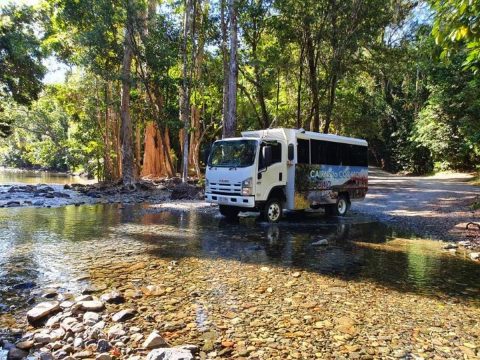
On a 1 day Cooktown 4WD tour, the route typically travels north via the Bloomfield Track and returns via the Mulligan Highway, which means Black Mountain is a natural stop on the way back through. It fits the day without any detour required.
You may also like: Bloomfield Track Guide – 4WD Road to Cooktown Explained
Explore Cairns
Cooktown
Venture into Far North Queensland on a small-group 4WD adventure to historic Cooktown. Traverse the legendary Bloomfield Track and discover fascinating Indigenous and colonial history on 1-day or 3-day tours.
See Cooktown toursFrequently asked questions
Is Black Mountain part of a national park?
Yes. Black Mountain is the centrepiece of Kalkajaka National Park, a 781-hectare protected area managed jointly by Queensland Parks and Wildlife Service and the Eastern Kuku Yalanji traditional owners. The park was formally renamed Kalkajaka National Park in 2021.
Why is Black Mountain black?
The boulders appear black due to a thin layer of microscopic algae growing on their exposed surfaces. The underlying rock is actually a grey to white granodiorite, a form of granite. The algae coating gives the mountain its distinctive dark appearance against the surrounding landscape.
Is it safe to visit Black Mountain?
The viewing platform and car park are safe and accessible. Venturing beyond that point is not permitted and is genuinely dangerous – the boulder maze creates a disorienting interior with drop-offs, poor air quality, and extreme heat. The restrictions are there for good reason.
How long do you need at Black Mountain?
Most visitors spend 15 to 20 minutes at the viewing platform, enough time to take in the scale of the formation, read the interpretive displays, and appreciate the contrast between the black boulders and the green country around them. It is a natural pause on the drive rather than a destination in its own right.
Ready to explore Cooktown?
Black Mountain is one of those stops that leaves an impression long after the drive home, a place with enough geology, ecology, and cultural depth to reward even a short visit. It is one of several highlights included on many Cooktown itineraries.
Cairns Discovery Tours has been guiding visitors to Cooktown for decades, operating purpose-built 4WD vehicles with experienced local guides who know the roads, the conditions, and the stories behind them. Whether you have one full day or prefer a slower three-day journey north, there is a Cooktown tour built around your trip.
Browse all Cooktown tours from Cairns to find the right fit, call the team on (07) 4028 3567, or get in touch by email if you have questions about which option suits your group best.