Skip to main content Skip to footer
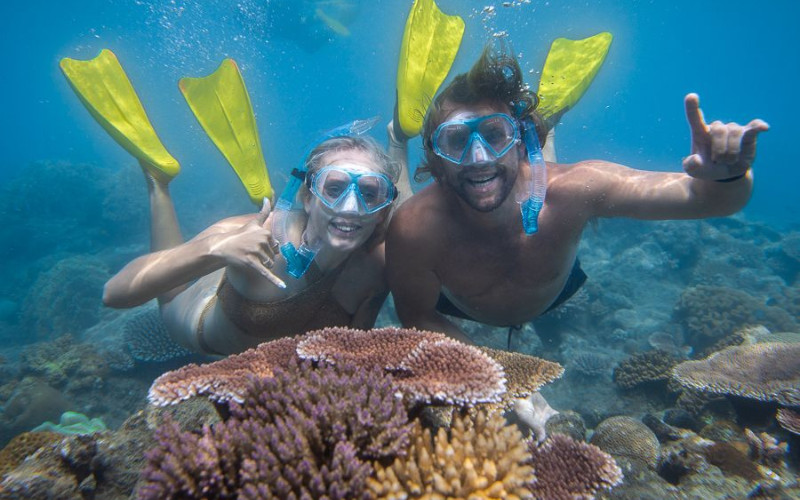
Most people spend weeks or months looking forward to their reef day. Then the morning arrives, and somewhere between packing the bag and finding the dock, the questions start. How long is the boat ride? What do they actually do when they get there? Is lunch included? What if the weather’s rough? What if they feel sick?
These are all fair questions, and most of them have straightforward answers. This guide walks through a typical Great Barrier Reef day tour from Cairns, from departure to return, so you know exactly what to expect and can focus on the parts that actually matter: what’s waiting for you below the surface.
Before you leave: the morning of your tour
Getting to the departure point
Most reef day tours depart from the Reef Fleet Terminal on Cairns Marina on the waterfront, a short walk from the centre of town. A small number of operators depart from the Cairns Marina nearby. Your booking confirmation will specify which terminal and what time to arrive.
Arrival time is typically 15 to 30 minutes before departure. Check-in involves collecting your boarding pass, paying for any optional extras (like an introductory dive or professional photos), and getting your snorkel gear fitted if the operator issues it before boarding.
What to bring on the day

Most tours provide snorkel equipment, a stinger suit or wetsuit, and lunch. What to bring from your end:
- Reef-safe sunscreen – applied before you leave, not on the boat
- Towel – most vessels have limited hire towels
- Hat and a light layer for the boat ride
- Swimwear worn under your clothes
- Water bottle
- Seasickness medication – taken 30 to 60 minutes before departure
- Cash or card for optional extras – intro dives, drinks, and professional photo packages are usually paid separately
- Waterproof phone case or underwater camera if photos matter to you
Leave valuables at the hotel. You’ll be in the water for most of the day.
For a more detailed breakdown, check out our packing guide for the Great Barrier Reef
The boat ride out
How long is the journey?
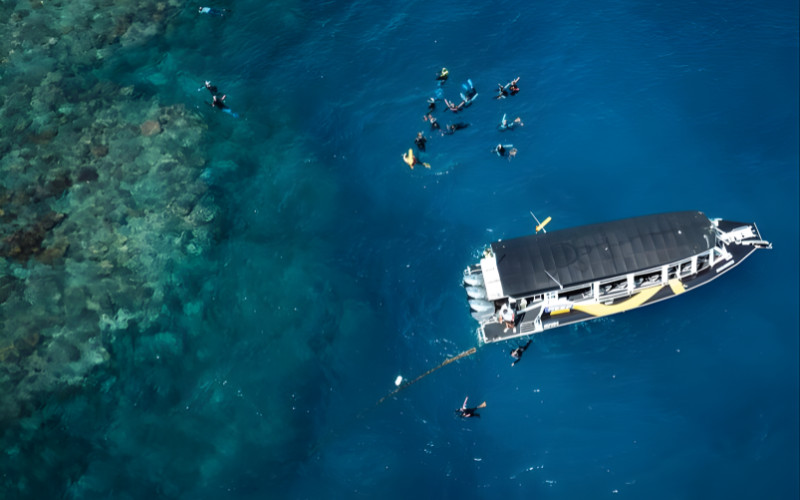
The outer reef sits roughly 50 to 80 kilometres offshore from Cairns, depending on the site. Most day tours take between 60 and 90 minutes to reach the first reef location. This is not a short trip – it’s something to prepare for, not be surprised by.
On a calm day, the ride out is genuinely enjoyable. The Coral Sea opens up ahead of you, the Cairns skyline shrinks behind, and somewhere around the 45-minute mark, the colour of the water shifts from greenish-grey to a deep tropical blue. On rougher days, especially from July to August, when trade winds are more consistent, it can be choppy.
Making the most of the boat ride
- Sit towards the middle of the vessel – it moves the least
- Stay on deck and keep your eyes on the horizon if you feel queasy
- Avoid reading or looking at your phone – this triggers nausea faster than almost anything else
- Eat a light breakfast before boarding – empty stomachs don’t cope well at sea
- Use this time to attend the onboard briefing, which usually happens during the outward journey
The safety briefing
Every reputable reef tour includes a safety and snorkel briefing before anyone enters the water. This covers how to use the mask and snorkel correctly, the boundaries of the swimming area, what marine life to be aware of, and how to signal for help if you need it. Pay attention to this even if you’ve snorkelled before – each site has its own layout, and the crew knows the specifics.
Arriving at the reef
What does it look like when you arrive?
The first thing most people notice is the colour of the water. At the outer reef on a clear day, it’s an almost unreal shade of blue-green – the kind that makes you reach for your phone before the anchor has even dropped. In June through October, visibility regularly reaches 20 metres. You can see the coral structures below before you’re anywhere near the water.
Most day tours visit two to three different reef sites over the course of the day, spending 45 minutes to an hour at each. Moving between sites is part of how operators give you variety – different coral formations, different fish populations, different depth profiles.
Pontoon vs. direct boat access
Some operators moor at a permanent reef pontoon – a floating platform anchored at the outer reef. These have enclosed snorkelling lagoons, deck seating, shaded areas, and, in some cases, underwater observatories or semi-submersible tours. They’re ideal for families and less confident swimmers.
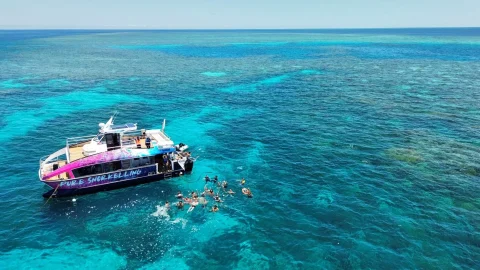
Other operators anchor the main vessel directly at reef sites and deploy a floating platform or swim ladder for water access. This is the more common day tour format and gives you more flexibility – you can snorkel away from the crowd and explore on your own terms.
In the water: what you’ll actually see

The snorkelling experience
You’ll enter the water from a swim platform or ladder at the back of the vessel. The crew is typically in the water and on deck throughout. If you’re new to snorkelling, they’ll help you get your mask sealed correctly and breathing through the tube before you head off.
The reef starts appearing almost immediately beneath you. What you encounter from there depends on the site, the season, and a little luck – but here’s a realistic sense of what most visitors see on a typical outer reef day from Cairns:
- Coral formations – hard corals in plates, branches, and domes; soft corals waving in the current; formations that start just one to two metres below the surface at some sites
- Reef fish – parrotfish, wrasse, surgeonfish, triggerfish, and the famously unbothered Maori wrasse – a large, blue-green fish that often approaches snorkellers out of pure curiosity
- Sea turtles – green turtles are a near-daily sighting on most outer reef sites and seem entirely unconcerned by the presence of humans
- Giant clams – some over a metre wide, sitting open in the shallows with their distinctive patterned mantles
- Reef sharks – whitetip and blacktip reef sharks are commonly seen and entirely non-threatening; they’ll move away if you approach
- Clownfish – yes, in actual anemones, though sometimes you have to look carefully
Seasonal highlights add another layer. Dwarf minke whales visit the northern outer reef from June to July. Manta rays pass through certain sites during the cooler months. Whale sharks are a rare but possible sighting year-round.
How deep is the snorkelling?
Most snorkelling at the outer reef sits in the three to ten metre range. Some shallow sections are as little as one to two metres deep – you’re practically floating over the top of the coral. The crew will point out the better sections at each site.
If you want to get closer to deeper formations, duck-diving below the surface gets you there – but it’s entirely optional. You’ll see plenty from the surface.
What if you don’t want to get in the water?
Not everyone does, and that’s completely fine. Most reef tours offer alternatives:
- Glass-bottomed boat – a guided ride over the reef with views through a transparent hull
- Semi-submersible – a vessel with submerged windows at eye level with the reef
- Underwater observatory – accessed via stairs on some reef pontoons, with 360-degree views of the coral
These are particularly good options for older travellers, young children not yet comfortable in the water, or anyone managing a minor health issue on the day.
Optional extras: what’s available on the day
Most reef day tours include snorkelling and standard equipment as standard. Beyond that, several optional activities can be added – usually at additional cost, paid at check-in or onboard:
| Activity | What It Involves | Suitable For |
| Introductory scuba dive | Supervised an underwater dive, no certification needed | Anyone in good health, usually 12+ years |
| Certified dive | Independent dive for qualified divers | Certified divers only |
| Helicopter scenic flight | 10-15 min flight over the reef (departs from pontoons) | Anyone wanting an aerial perspective |
| Professional photos | An underwater photographer documents your snorkel | Those who want quality reef photos |
| Glass-bottomed boat / semi-sub | Reef viewing without swimming | Non-swimmers, families with young kids |
Introductory dives are one of the more popular upgrades for first-timers. A qualified instructor briefs you on the vessel and stays with you at all times underwater. No prior experience is required, though a short health questionnaire is standard. If you’re keen to try, the Great Barrier Reef tour with Great Adventures runs intro dives from their outer reef pontoon – the platform entry is designed for beginners.
For a full breakdown of what different reef tours cost, including add-ons like intro dives and scenic flights, see the reef tour cost guide.
Explore Cairns
Great Barrier Reef
Explore one of the world’s greatest natural wonders with daily reef tours from Cairns. Snorkel, dive or cruise the coral with options to suit every age and ability.
See reef toursLunch and time on deck
Most full-day reef tours include a buffet or set lunch served on the vessel, typically between snorkel sessions. Quality varies by operator – some offer a solid hot spread, others a simpler cold buffet. If dietary requirements apply, flag these at the time of booking rather than on the day.
Use the time between snorkels to dry off on deck, grab a drink, review your underwater photos, and rest before the next session. Most people fit in two to three snorkels across the day with rest time in between.
The bar on most vessels serves cold drinks – alcoholic and non-alcoholic – at an additional cost. It’s also worth knowing that most tour prices include the Environmental Management Charge (EMC), a small government levy per person that goes directly towards Great Barrier Reef management and conservation.
The ride home
The return journey to Cairns takes roughly the same time as the outward leg – 60 to 90 minutes depending on the site and sea conditions. Most tours are back at the Reef Fleet Terminal by late afternoon, typically between 4 pm and 6 pm.
A few practical notes for the return:
- Wind typically picks up in the afternoon, so the return leg can be choppier than the outward journey, especially in the dry season (June to October)
- If you’ve taken an introductory dive, you cannot fly within 12 to 24 hours due to decompression considerations – this matters if you have an early flight the following day
- Many people find they sleep on the boat home. That’s not a sign of a bad day – it’s a sign of a full one.
A typical reef day tour – snapshot timeline
| Time | What’s Happening |
| 7:00 – 7:30 am | Arrive at Reef Fleet Terminal, check in, and collect gear |
| 7:30 – 8:00 am | Depart Cairns |
| 9:00 – 9:30 am | Arrive at the first reef site; safety briefing |
| 9:30 – 11:00 am | First snorkel session; optional intro dive |
| 11:00 am | Move to the second site |
| 11:30 am – 1:00 pm | Second snorkel session; lunch served on the vessel |
| 1:00 pm | Move to the third site (if included) |
| 1:30 – 2:30 pm | Third snorkel or activity session |
| 3:00 pm | Depart for Cairns |
| 4:30 – 5:30 pm | Arrive back at Reef Fleet Terminal |
Times vary by operator and conditions. This is a general guide, not a fixed schedule.
Things that catch people off guard (and how to handle them)
The boat ride is longer than people expect. Three hours of travel for a full-day tour is normal. It’s part of the experience, not wasted time – but knowing it in advance means you prepare for it rather than spending that time anxious.
Conditions on the reef can differ from what was forecast. The ocean doesn’t follow a script. Crew adjusts plans based on conditions on the day – if a site is too rough, they move to an alternative. Trust the operators. They know these waters well and are not inclined to take risks.
Underwater colours look different without the sun. Overcast skies make coral look muted and grey. When the sun is directly overhead and the water is calm and clear, the reef lights up – coral formations in orange, purple, gold, and electric blue. This is why morning departures and the dry season tend to deliver better underwater visuals.
Stinger suits are provided during the wet season. If you’re visiting between November and May, the crew will issue full-length Lycra stinger suits before you enter the water. These cover your arms and legs and protect against marine stingers. They double as sun protection, so there’s no downside to wearing one even outside stinger season if the operator offers them.
You won’t feel like you’ve seen the whole reef. Around 3,000 individual reefs make up the Great Barrier Reef. Your tour will visit two or three sites covering a small fraction of the system. That’s not a disappointment – it’s genuinely a reason to return.
Photos from a waterproof phone case are rarely as good as you hope. The professional onboard photographers know the sites, the light, the fish, and where to position themselves for the best shots. If photos matter to you, their packages are almost always worth it.
You may also like: Best Time to Travel to Cairns

Explore Cairns
Reef Helicopter Tours
See the Great Barrier Reef from breathtaking altitude on a scenic helicopter flight from Cairns. Combine aerial views with snorkelling and reef pontoon visits for the ultimate reef experience.
See helicopter toursFrequently asked questions
What is included in a Great Barrier Reef day tour from Cairns?
Most full-day reef tours include return boat transfers to the reef, full snorkel equipment (mask, fins, snorkel, wetsuit or stinger suit), two to three snorkel sessions at different reef sites, a buffet or set lunch, and freshwater showers onboard. Some tours also include a glass-bottomed boat ride or semi-submersible tour. Introductory dives, scenic helicopter flights, and professional photos are typically available at additional cost.
How long does a reef day tour take?
A typical full-day tour runs from around 7:30 am to 5 pm. This includes travel time to and from the reef (around 90 minutes each way), two to three hours of snorkelling across multiple sites, and time for lunch and rest on the vessel.
What if the weather is bad on the day of my tour?
Reef tours operate in most conditions, and operators have the authority to adjust sites or activities if conditions at a particular location are unsafe. In rare cases of severe weather, tours may be rescheduled – your operator or booking agent will contact you directly. It’s worth noting that overcast skies don’t cancel a tour; they just affect underwater lighting.
Is food provided on a reef day tour?
Yes – most full-day tours include a buffet or set lunch. Light snacks and cold drinks are often available throughout the day at an additional cost. If you have dietary requirements, notify the operator when booking.
Can I do a reef tour if I have a medical condition?
Snorkelling is low-impact and suitable for most people. Introductory scuba dives require a health questionnaire and are not suitable for certain conditions, including heart conditions, respiratory conditions, and pregnancy. Check the specific requirements with your operator before booking, and consult your doctor if you’re unsure.
Do I need to book a reef tour in advance?
During peak season – June to October – and school holiday periods, the most popular tours book out well in advance. Even outside these periods, booking a few days ahead is recommended to secure your preferred date and tour type.
You may also like: Great Barrier Reef snorkelling vs diving
Ready to book your reef day?
A Great Barrier Reef day tour from Cairns is one of those days you remember long after the sunscreen has worn off. Our team knows the operators, the boats, and the reef sites – and Cairns Discovery Tours can match your group with the right trip based on what matters most to you.
Browse Great Barrier Reef tours from Cairns, call us on (07) 4028 3567, or drop us a line – we’ll walk you through your many wonderful options.