Skip to main content Skip to footer

Sea turtles have been swimming the Earth’s oceans for over 100 million years. They were here before the dinosaurs disappeared, before the Great Barrier Reef formed, and long before humans existed. When you encounter one while snorkelling the outer reef, you are sharing the water with an animal whose lineage predates almost everything else alive on the planet – and that is worth taking a moment to appreciate.
On the Great Barrier Reef, sea turtles are not rare sightings reserved for lucky visitors. They are permanent residents. Green turtles graze on seagrass beds in the shallows, hawksbills probe reef crevices for sponges, and loggerheads cruise open water between reef systems. Most visitors on a day reef tour encounter at least one turtle, and many see several. This guide covers the species you are likely to meet, what they are doing when you see them, where and when sightings are most likely, and why these ancient animals still need our protection.
Sea turtle species on the Great Barrier Reef
Six sea turtle species exist globally, and four of them inhabit the Great Barrier Reef with any regularity. Of those four, the green turtle and the hawksbill are the species you are most likely to encounter on a Cairns reef tour. The other two – the loggerhead and the leatherback – are present but far less commonly seen from reef platforms and day-trip vessels. Each species has a distinct diet, behaviour, and ecological role, and understanding those differences makes any encounter considerably more meaningful.
Green sea turtle
The green sea turtle is the species most visitors encounter, and for straightforward reasons. It is the most numerous turtle on the reef, the most tolerant of human proximity, and it feeds in open areas where it is easy to spot from the surface. Adults grow to around 80-120 centimetres and weigh between 100-150 kilograms, making a full-grown green turtle a genuinely substantial animal to come across in the water.
Despite the name, green turtles are not particularly green on the outside. The name comes from the colour of their fat, which turns greenish from a lifelong diet of seagrass and algae. Adults are almost entirely herbivorous, grazing in much the same way cattle graze on grass – slow, deliberate, methodical. Watch one feeding, and you will see it moving steadily across sandy seagrass beds, biting and moving in an unhurried rhythm. There is no urgency to the behaviour because nothing it is eating is going to escape.
This herbivorous lifestyle gives green turtles their calm, docile manner, and it also serves an important ecological function. Regular grazing keeps seagrass beds healthy and productive, preventing overgrowth that would reduce the diversity of fish, invertebrates, and other marine life that these beds support.
Green turtles take 25-50 years to reach breeding age. When females finally do, they return to the exact beach where they were born to lay their eggs – locating that specific beach after decades at sea and thousands of kilometres of open ocean travel.
Green turtle populations on the Great Barrier Reef have increased since strong protection measures were introduced in the 1970s and 1980s, with some nesting beaches seeing numbers double since the 1990s. The species remains globally vulnerable, but the recovery on this reef is one of Australian marine conservation’s genuine success stories. The Great Barrier Reef Foundation tracks population trends and conservation efforts across the region.
Hawksbill sea turtle
The hawksbill sea turtle is smaller and less commonly encountered than the green turtle, but its ecological role on the reef is also important. Hawksbills are named for their distinctive, narrow, pointed beak – a precision feeding tool evolved specifically for extracting sponges from reef crevices. Where the green turtle is an open-water grazer, the hawksbill is a specialist reef hunter, and the difference in behaviour is immediately visible if you know what to look for. A hawksbill navigates reef structure with purpose, pausing at crevices and probing methodically rather than moving across open sand. If you see a turtle working systematically through reef formation rather than grazing in open water, it is almost certainly a hawksbill.
Sponge predation is critically important for coral reef health. Left unchecked, sponges can overgrow and smother coral – particularly when rising water temperatures or bleaching events already stress reefs. Hawksbills keep sponge populations in check, maintaining the balance that allows coral to dominate healthy reef systems. Reefs without hawksbills show measurable increases in sponge coverage and corresponding decreases in coral health, which gives this relatively small turtle an outsized influence on the reef ecosystem around it.
Adults are typically 60-90 centimetres long, with overlapping shell scales that give them a distinctive appearance. They are shyer than green turtles and less tolerant of human approach – another reason sightings are less common despite the hawksbill being a genuine reef resident. Globally, hawksbills are critically endangered. Historical shell trade devastated populations across the Indo-Pacific, and while international protections are now in place, population recovery is slow given the species’ extended time to breeding age. Hawksbill numbers on the Great Barrier Reef are stable but remain a fraction of what they once were.
Loggerhead sea turtle
The loggerhead sea turtle takes its name from its proportionally large head, which houses the powerful jaw muscles needed to crush hard-shelled prey. While green turtles graze vegetation and hawksbills extract sponges, loggerheads eat molluscs, crustaceans, and other invertebrates that require serious mechanical force to open. This dietary specialisation makes the loggerhead a different kind of reef visitor – less a resident of the reef structure itself and more a user of open water habitat between reef systems.
On the Great Barrier Reef, loggerheads are less common than greens or hawksbills and more often encountered in open water than on reef platforms. Day-trip visitors occasionally see them, but sightings are not as reliable as green turtle encounters. Loggerheads are classified as vulnerable globally, though eastern Australian populations are considered stable due to protective measures introduced in recent decades.
Leatherback sea turtle
The leatherback sea turtle is the world’s largest turtle, with adults reaching 1.5 metres in length and weighing over 700 kilograms. Unlike every other sea turtle species, leatherbacks have a flexible, leathery shell rather than a hard one – a streamlined profile that suits their lifestyle as deep-water divers in the open ocean. They feed almost exclusively on jellyfish and cover enormous distances across open water in the course of their lives.
Leatherbacks rarely appear on reef platforms or in shallow coastal waters, and encountering one on a standard reef tour would be genuinely exceptional. Most marine biologists working regularly on the reef go years without seeing one. The species is Critically Endangered, with global populations declining steadily. Plastic ingestion is a significant threat, given that plastic bags are indistinguishable from jellyfish when viewed from below the surface.
For a full breakdown of which turtle species inhabit the Great Barrier Reef and their current conservation status, the Queensland Government’s turtle species guide covers identification, distribution, and population monitoring across the region.
Turtle species at a glance
The four species you might encounter on the Great Barrier Reef each have distinct characteristics, diets, and conservation status. It is worth knowing the differences before you head out on the water – recognising which species you are looking at, and understanding what it is doing, makes the encounter considerably richer. The table below is a quick reference to carry into the day.

| Species | Adult size | Diet | Conservation status | Encounter likelihood |
| Green sea turtle | 80-120 cm | Seagrass and algae | Vulnerable | High – most common sighting |
| Hawksbill sea turtle | 60-90 cm | Sponges | Critically Endangered | Moderate – shyer, reef crevices |
| Loggerhead sea turtle | 90-120 cm | Molluscs and crustaceans | Vulnerable | Low – open water species |
| Leatherback sea turtle | 130-180 cm | Jellyfish | Critically Endangered | Very rare – oceanic wanderer |
What turtles are doing when you see them
Understanding turtle behaviour transforms a sighting from a passive observation into genuine wildlife watching. Turtles encountered on the reef are always doing something specific, and recognising what that is changes the way you experience the encounter.
Feeding
A turtle moving slowly and deliberately across sandy or seagrass areas is almost certainly feeding. Green turtles graze methodically, taking bites and moving forward in a rhythm that looks almost meditative from the outside. They pay minimal attention to nearby snorkellers when feeding because food is the priority and nothing about a human in the water changes that for them.
Hawksbills feed differently – they navigate reef structure with purpose, pausing at crevices and working their beak into gaps with focused precision. The movement pattern is quite different from open-water grazing, and once you have seen both behaviours, you will find it easy to tell the two species apart even before you get a clear look at them.
The important thing when encountering a feeding turtle is not to interfere. Hovering directly above a feeding turtle or making sudden movements causes it to abandon the feeding spot and flee – wasting energy it needs for survival and reproduction. Keep your distance, move slowly, and let it eat.
Resting
Green turtles rest frequently during the day, often wedging themselves under coral overhangs or into reef caves where they are surprisingly difficult to spot. Their shape blends well with reef structure when they are still, and they can hold their breath for extended periods during rest, so there is no regular surfacing to give them away.
A resting turtle should be left entirely undisturbed. Approaching one causes it to flee, consuming significant energy in the process. If you find a turtle resting under coral, observe from a respectful distance and move on rather than lingering.
Breathing
Sea turtles breathe air through lungs – they cannot extract oxygen from water the way fish do. During active feeding, green turtles surface roughly every 5-10 minutes. During deep rest, they can hold their breath for considerably longer.
When snorkelling, you will sometimes see a turtle ascending steadily toward the surface, taking a single unhurried breath, and descending again in one smooth arc. It is one of the more graceful things you will see on the reef. If a turtle near you is surfacing repeatedly at short intervals, it may be stressed and exerting itself to move away. That is a clear signal to give it more space.
Migration
Many Great Barrier Reef turtles are year-round residents, but others undertake remarkable migrations between reef feeding grounds and distant nesting beaches. Green turtles tagged in Queensland have been tracked travelling to nesting beaches in Papua New Guinea, Vanuatu, and New Caledonia – thousands of kilometres from where they were feeding.
When females are ready to breed, which happens every 2-4 years, they stop eating entirely and redirect all energy toward reproduction. They migrate to nesting beaches with precision that still astonishes researchers, come ashore at night to lay eggs, and repeat the process several times across a single nesting season before returning to reef feeding grounds to recover. The whole cycle – migration, nesting, return – can take months, and the turtle does it without eating throughout.
Nesting, eggs, and hatchlings
Most visitors to the Great Barrier Reef see adult turtles in the water, and understanding the nesting cycle adds important context to any reef encounter and helps explain why turtle conservation is such a long-term undertaking.
Nesting in Queensland peaks between November and March. Females emerge at night to dig nests in sandy beaches above the high-water line, depositing 80-120 eggs per clutch before covering the nest carefully and returning to the ocean. A single female will repeat this 3-5 times across one nesting season, with each clutch laid roughly two weeks apart.
Eggs incubate in the sand for 45-75 days, and the temperature of the sand during incubation determines the sex of the hatchlings – warmer sand produces more females, cooler sand more males. This temperature-dependent sex determination is increasingly concerning as climate change warms beach sand. Monitoring at some northern Queensland nesting sites shows hatchling populations skewing heavily female, a long-term population issue that researchers are actively working to understand and address.
When hatchlings emerge, they do so at night and move immediately toward the ocean, guided by the brightness of the open horizon. Artificial lighting on beaches disorients them, causing hatchlings to move toward lights rather than seaward – one of the reasons coastal development near nesting beaches requires careful management.
Of every thousand hatchlings that reach the water, roughly one survives to adulthood. Most are eaten within hours of emerging. The survivors spend years in open ocean before returning to the reef and coastal waters as juveniles, and decades more before reaching breeding age. It is an extraordinarily slow-building population, which is precisely why adult mortality threats are so damaging to long-term turtle numbers.
Major Queensland nesting beaches include Mon Repos near Bundaberg – one of the largest green turtle nesting sites in the southern Pacific – and Heron Island in the southern Great Barrier Reef. Both offer guided nesting season viewing during November-March for visitors who want to experience the nesting process directly.
Why sea turtles are threatened
All four Great Barrier Reef turtle species face ongoing conservation challenges. Understanding what those challenges are helps visitors appreciate why responsible behaviour during water encounters matters well beyond any single interaction.
Fishing gear entanglement is among the most significant mortality sources for adult turtles. Turtles caught in gillnets, trawl nets, and longlines drown because they cannot surface to breathe. Turtle Excluder Devices – trapdoor mechanisms fitted into trawl nets – allow turtles to escape while retaining the catch, and Australian fishing regulations require these devices across many fisheries. The policy has demonstrably reduced turtle drowning mortality over time.
Boat strikes kill and injure turtles regularly, particularly in shallow coastal waters where turtles surface frequently to breathe. Turtles are slow, predictable, and spend considerable time near the surface – exactly where propellers operate. Speed restrictions in turtle habitat areas and boater awareness are the primary preventive measures.
Marine debris, particularly plastic, poses direct threats through ingestion. All turtle species ingest plastic debris, but leatherbacks are most vulnerable given their jellyfish diet. Plastic bags viewed from below the surface are indistinguishable from jellyfish, and ingestion causes internal injuries, blockages, and starvation. Reducing single-use plastic entering the ocean is one of the most meaningful individual contributions available to anyone who cares about reef wildlife.
Coastal development destroys nesting habitat and introduces artificial lighting that disorients hatchlings. Nesting beach protection – including fencing, lighting restrictions, and predator control programmes – helps maintain productive nesting sites near populated coastlines.
Climate change represents the most systemic long-term threat to turtle populations. Rising sea temperatures affect reef food sources and cause coral bleaching, which reduces hawksbill feeding habitat. Warming beach sand skews hatchling sex ratios toward female-heavy populations. Sea level rise threatens low-lying nesting beaches directly. These threats operate simultaneously and compound each other in ways that are difficult to manage individually.
Where and when to see turtles
Green turtles are present on the reef year-round, so there is genuinely no wrong time to visit if turtles are a priority for your trip. That said, a few conditions improve your chances of a meaningful encounter.
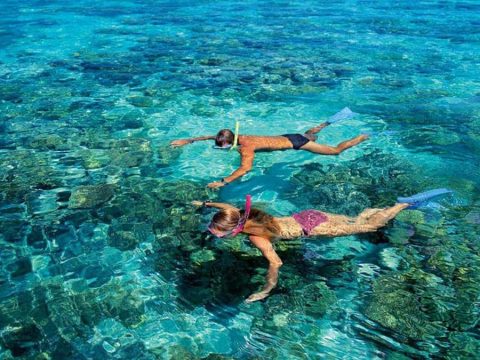
The dry season from May to October offers better water visibility – 20 metres or more on the outer reef – making turtles easier to spot from the surface. The wet season reduces visibility through runoff and increased suspended sediment, though sightings still occur regularly. Early morning and late afternoon tend to see more turtle activity than midday, when turtles are more likely to be resting. If you have a choice between morning and afternoon reef trips, the morning departure offers slightly better odds for active encounters.
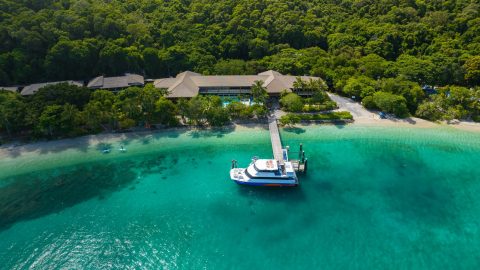
Outer reef platforms are productive turtle habitat, with seagrass and coral in abundance and turtles present as year-round residents. Most visitors on a full-day outer reef tour encounter at least one turtle during their snorkel sessions. Island day-trips to Green Island and Fitzroy Island also see regular turtle activity – Green Island in particular has consistent green turtle presence in its surrounding shallow waters, and the fringing reef makes turtle watching accessible even for inexperienced snorkellers. Some visitors see turtles from Green Island’s glass-bottom boat tours without needing to snorkel at all.

Explore Cairns
Reef Helicopter Tours
See the Great Barrier Reef from breathtaking altitude on a scenic helicopter flight from Cairns. Combine aerial views with snorkelling and reef pontoon visits for the ultimate reef experience.
See helicopter tours
The realistic expectation for a day reef tour is that more than half of the visitors will see at least one turtle. It is a likely encounter, not a guaranteed one. For those who make turtle sightings a genuine priority, a multi-day liveaboard trip increases the probability significantly through more time in the water across more sites and conditions.
Related reading: 5 reasons to visit the Great Barrier Reef
How to behave around turtles in the water
When you encounter a turtle, how you behave determines whether it is a positive experience for the animal or a stressful one. The guidelines below are straightforward and grounded in turtle biology – following them also tends to produce a better encounter for you, not just the turtle. A turtle that feels unthreatened will go about its business entirely indifferent to your presence, which is when you actually get to watch it properly.
- Keep your distance – stay at least one to two metres from any turtle you encounter. Closer approach stresses turtles, disrupts feeding and resting behaviour, and depletes energy reserves the animal needs for survival.
- Never touch a turtle – handling removes the protective mucus layer that defends against skin infection, causes measurable stress, and is illegal under Queensland and Commonwealth legislation.
- Do not chase or follow – if a turtle is moving away, it has a reason. Following it burns energy the animal needs and signals you as a threat rather than a neutral presence.
- Do not block its path to the surface – turtles need to breathe regularly, and positioning yourself between a turtle and the surface is a direct welfare concern.
- Never feed turtles – supplementary feeding habituates them to human presence, can introduce inappropriate food, and draws them toward areas with higher boat traffic.
- Follow your guide’s instructions – guides trained in responsible reef conduct know current conditions, recent animal behaviour patterns, and their operator’s specific protocols. Their guidance exists because it works.
Frequently asked questions
Are sea turtles dangerous?
Sea turtles are docile animals with no interest in threatening humans. They may bite if handled or cornered, but this is a defensive response rather than aggression. Keep your distance and behave calmly in the water, and you will have nothing to worry about.
Why are green turtles more commonly seen than hawksbills?
Green turtles are larger and more visible from the surface, more numerous on the reef, more tolerant of human proximity, and feed in open areas where they are easily spotted. Hawksbills are smaller, shyer, and feed in reef crevices – they are present on the reef but considerably less visible during a standard snorkel session.
Can you touch sea turtles?
No. Touching sea turtles is illegal under Queensland and Commonwealth law and causes genuine harm to the animal by removing the protective mucus layer on their skin. Observe from a respectful distance and resist the urge to reach out.
How long do sea turtles live?
Exact lifespans are difficult to determine because turtles outlive most research programmes. Current estimates suggest 50-80 or more years for most species. The 25-50 year time to breeding age means a turtle you see grazing on the reef today may well have hatched in the 1970s or 1980s.
Do Great Barrier Reef turtles migrate?
Some do and some do not. Many green turtles on the Great Barrier Reef are year-round residents that feed on reef seagrass and rest on reef structure throughout their lives. Others undertake migrations of thousands of kilometres to nesting beaches in Papua New Guinea, Vanuatu, or New Caledonia, then return to the same reef area after nesting.
What is the biggest threat to sea turtles?
It varies by species and region, but climate change represents the most systemic long-term threat – affecting nesting beach temperatures, coral food sources, and sea levels simultaneously. Fishing gear entanglement remains the most significant immediate mortality threat to adult turtles across most populations globally.
Can you see baby turtles on reef tours?
Rarely. Hatchlings emerge at night and immediately head to the open ocean, spending years in pelagic waters before returning to the reef and coastal areas as juveniles. If hatchling or nesting activity is what you are hoping to see, Mon Repos near Bundaberg runs guided turtle nesting encounters during the November-March season.
See Great Barrier Reef turtles for yourself
A turtle encounter on the Great Barrier Reef tends to stay with people in a way that many other experiences do not. Part of that is the animal itself – watching something that large move through water with such unhurried ease is genuinely beautiful. Part of it is the context: knowing you are in the presence of an animal 100 million years in the making, one whose population on this reef is recovering because people made deliberate choices to protect it. That combination of wonder and perspective is hard to manufacture. Out here, it just happens.
Cairns Discovery Tours has been connecting visitors with the Great Barrier Reef for over 30 years, and our team knows this reef and its wildlife well. Whether you want help choosing between a full-day outer reef tour and an island day-trip, or you just want to know where turtles have been active recently and what conditions are looking like, we are happy to talk it through.
Give us a call on (07) 4028 3567 or send us an email and let us help you plan a reef day worth remembering.