Skip to main content Skip to footer

There’s a moment that happens on almost every Great Barrier Reef snorkel tour – someone spots a flash of orange tucked into a swaying cluster of tentacles, freezes, and whispers something like “wait, is that…?” It is. That’s Nemo – the real one.
When Pixar released Finding Nemo in 2003, they didn’t invent a fantasy creature. They based their characters on actual clownfish biology, and while the story is fiction, almost everything about Nemo’s underwater world is surprisingly accurate. The reef is real. The anemone is real. And the fish that lives inside it – vivid orange, boldly striped, darting in and out with more confidence than its size warrants – is absolutely real. For children who’ve watched the film a dozen times, spotting their first clownfish in the wild is one of those travel moments that sticks.
This guide covers what clownfish actually are, how their partnership with sea anemones works, which species you’ll find on the Great Barrier Reef, what the film got right (and one thing it got spectacularly wrong), and how to find them on your reef visit.
What are clownfish?
Clownfish – also called anemonefish – are small reef fish belonging to the family Pomacentridae. There are 30 known species worldwide, all living exclusively in the warm, shallow waters of the Indian and Pacific Oceans. They range from about 7 to 17 centimetres in length, which makes them easy to miss if you’re moving too fast through the water.
The name “clownfish” comes from their bold colouration and distinctive swimming style – they move in a bobbing, almost exaggerated motion that looks nothing like the streamlined efficiency of most reef fish. The name “anemonefish” is arguably more accurate, though, because the sea anemone isn’t just home for these fish. It’s their entire world. A clownfish without an anemone is in serious trouble.
The species Nemo is directly based on is the orange clownfish (Amphiprion percula) – vivid orange with three white bands edged in black. It’s the one most people picture, and it’s one of the most commonly spotted species during Great Barrier Reef day tours.
For a closer look at the biology and classification, the Great Barrier Reef Foundation’s clownfish profile is a good starting point.
Clownfish species on the Great Barrier Reef
The Great Barrier Reef hosts several clownfish species, each with different colouration, anemone preferences, and temperament. Here’s a quick overview:
| Species | Appearance | Temperament | Preferred anemone |
| Orange clownfish (Amphiprion percula) | Vivid orange, 3 white bands with bold black edges | Moderately territorial | Magnificent sea anemone, giant carpet anemone |
| False clown anemonefish (Amphiprion ocellaris) | Almost identical to percula – slightly lighter with thinner black edging | Similar to percula | Magnificent sea anemone |
| Maroon clownfish (Premnas biaculeatus) | Dark red-maroon, thin white bands, largest species at up to 17 cm | Noticeably aggressive – will charge at divers | Bubble-tip anemone |
| Pink anemonefish (Amphiprion perideraion) | Pinkish-orange with a single dorsal white stripe | Quieter, less confrontational | Magnificent sea anemone |
Both percula and ocellaris are so similar that most visitors – and even some guides – can’t tell them apart in the water. Either way, they’re both the fish the film is based on, and both are equally delightful to find.

You may also like: 5 reasons to visit the Great Barrier Reef
How the anemone partnership works
The relationship between clownfish and sea anemones is one of the most studied examples of mutualism in marine biology – a partnership where both species genuinely benefit from the arrangement. Understanding how it works makes the encounter far more interesting than simply spotting a pretty fish.
Sea anemones are predatory animals, not plants, despite looking like underwater flowers. Their tentacles are lined with stinging cells called nematocysts that paralyse small fish and invertebrates on contact. For most reef creatures, brushing against anemone tentacles is immediately fatal. Clownfish, somehow, are immune.
The immunity isn’t inherited – it’s earned. When a clownfish moves into a new anemone, it goes through a careful, deliberate process called acclimation. It rubs itself gradually against the tentacles over several hours, prompting the anemone to coat the fish’s scales in its own protective mucus. Once covered in that mucus, the clownfish essentially smells like part of the anemone, and the stinging cells don’t fire. Remove that mucus layer – which happens if the fish is separated from its host for too long – and the protection disappears.
What does the anemone get in return? Quite a lot, actually:
- Clownfish are aggressively territorial and will drive away butterflyfish that would otherwise feed on the anemone’s tentacles
- Clownfish waste provides nitrogen that functions as fertiliser for the anemone
- Some research suggests that the clownfish’s swimming behaviour improves water circulation around the anemone
The Great Barrier Reef Marine Park Authority describes the the clownfish and anemone relationship as one of the reef’s most iconic examples of species interdependence. It’s a relationship that took millions of years of co-evolution to produce – and you can watch it playing out live from the surface on a snorkel.
What Finding Nemo got right (and very wrong)
Finding Nemo is surprisingly accurate about clownfish biology in several respects. What it got spectacularly wrong is something marine biologists love to bring up.
What the film got right:
- Clownfish do live in anemones
- They are territorial and defend their host aggressively
- They live in small family groups within a single anemone
- Marlin’s anxiety about venturing into open water is biologically reasonable – clownfish rarely move more than a few metres from their anemone
- The reef environment, coral colours, and behaviour of surrounding species are depicted with genuine accuracy
What the film got spectacularly wrong:
The sex of the main characters.
Clownfish are sequential hermaphrodites – all clownfish are born male. Within any anemone, there’s a strict hierarchy: the largest individual is always the breeding female, the second largest is the breeding male, and all others are non-breeding males. If the female dies or disappears, the breeding male changes sex and becomes female. The next male in line moves up.
In Finding Nemo, when Coral is eaten at the start of the film, Marlin should have changed sex and become female. Then Nemo, upon hatching, should have become the new breeding male. The film’s entire premise is biologically inverted.
This is worth explaining to kids at the reef – the real story of how clownfish families work is arguably more fascinating than the movie’s version.
Nemo’s home: sea anemones on the Great Barrier Reef
Anemones are almost always mistaken for plants by first-time reef visitors. The flower-like appearance, the rooted position, the waving tentacles – it’s an understandable confusion. But anemones are animals, and active predators at that.
The Queensland Parks and Wildlife Service guide to connected creatures of the Great Barrier Reef, it describes the anemone-fish partnership as one of the reef’s most visible examples of species connection. The Great Barrier Reef hosts ten sea anemone species that clownfish associate with. Not every anemone will host clownfish, and clownfish are similarly selective – each species has preferred anemone partners they’ve co-evolved with over millions of years.
The three most commonly encountered anemone types hosting clownfish on the reef are:
- Magnificent sea anemone – often seen in vivid purple, pink, or green; the most common host for orange and pink clownfish species
- Giant carpet anemone – can reach a metre in diameter; lies flat on the reef surface in sandy areas adjacent to coral
- Bubble-tip anemone – identifiable by the distinctive bubble shapes on the ends of its tentacles; the exclusive host of the maroon clownfish
Anemones are sensitive to water temperature and quality. When bleaching events occur, the stress affects anemones directly, and a bleached or dying anemone leaves its resident clownfish completely exposed. The health of clownfish populations on the reef is tied directly to reef health overall.
Where to find clownfish on the reef
Clownfish don’t roam. If there’s a clownfish in a particular anemone today, it will be there tomorrow – and likely for years. They’re among the most reliable wildlife sightings on a reef tour precisely because they stay put.
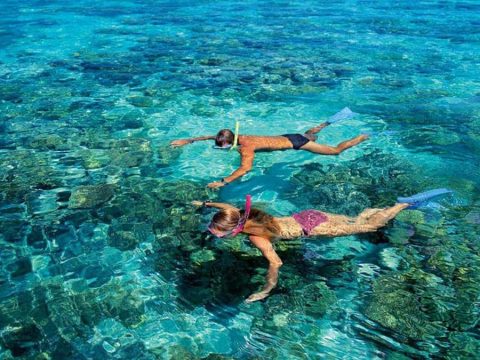
Anemones typically grow in shallow reef areas with good light, moderate current, and firm substrate to anchor to. On outer reef platforms, look for them in coral gardens at 3-12 metres depth, particularly on reef slopes.
Practical tips for spotting clownfish while snorkelling:
- Slow down. Moving too fast is the single biggest reason people miss clownfish. Pick a coral area and hover for a few minutes rather than covering distance.
- Look for the anemone first, not the fish. Anemones are larger and more visually distinct – a bright pink or purple cluster of tentacles stands out against the coral.
- Watch for movement at the edge of your vision. Clownfish often dart a short distance out from the anemone, then immediately retreat. That flicker of orange is often your first clue.
- Ask your guide. Guides who work the same reef site week after week know exactly which anemones are occupied and the best viewing angles. There’s no need to search randomly.
- Check sandy areas adjacent to coral. Carpet anemones in particular tend to sit on open sandy substrate near coral edges, not on the coral structure itself.

Related reading: 3 best islands to visit at the Great Barrier Reef

Explore Cairns
Reef Helicopter Tours
See the Great Barrier Reef from breathtaking altitude on a scenic helicopter flight from Cairns. Combine aerial views with snorkelling and reef pontoon visits for the ultimate reef experience.
See helicopter toursClownfish facts for kids
Children who love Finding Nemo tend to be genuinely fascinated by the real biology behind the film. Here are some facts worth sharing on your reef visit.
- All clownfish are born male. When the female of a family group dies, the largest male changes sex to become female. If the film were biologically accurate, Marlin would have become Nemo’s mum.
- Clownfish almost never leave their anemone. Marlin’s cross-ocean journey is extraordinary by clownfish standards – in reality, they rarely venture more than a few metres from home.
- The immunity is earned, not inherited. Clownfish spend hours carefully rubbing against the anemone’s tentacles when they first move in, gradually acquiring the protective mucus coating. It looks almost like a negotiation.
- Clownfish communicate using clicking sounds. They grind their teeth together to produce clicks and pops that establish territory and social status within the group.
- The female is always the boss. The largest fish in any anemone is always female and always the dominant individual. The male defers to her in almost every interaction.
- The dad guards the eggs. The male fans and guards the egg clutch constantly until they hatch. This part Finding Nemo actually got right – Marlin’s devotion to the eggs at the start of the film reflects real clownfish behaviour.
Why clownfish matter beyond being adorable
Clownfish have genuine ecological importance beyond their popularity with reef visitors and Pixar animators.
Their relationship with anemones is one of the reef’s most visible examples of mutualism – a category of species interaction where both participants benefit. These relationships are the foundation of reef biodiversity. The reef isn’t a collection of independent animals living side by side; it’s an interconnected web of thousands of species whose survival depends on each other. The Great Barrier Reef Foundation’s marine life directory covers this full spectrum, from the microscopic algae living inside coral tissue to the whale sharks that occasionally pass through reef waters.
Clownfish are also useful indicators of reef health. A reef with thriving clownfish populations has healthy anemones, which means it gets the appropriate water temperature, good water quality, and sufficient light penetration. When clownfish populations decline, it often signals anemone stress before that stress becomes visible in any other way.
This anemone-fish partnership is one of the reef’s most visible examples of species connection – and it’s visible precisely because anemones are large, colourful, and stationary. This makes the partnership easy to observe compared to more cryptic reef relationships.
Related reading: Best day trips from Cairns: a guide for first-timers
Frequently asked questions
Can you see clownfish while snorkelling, or only while diving?
Clownfish are absolutely accessible to snorkellers – they live in shallow reef areas where anemones grow, typically at 3-12 metres depth. In clear water, which is standard on outer reef platforms during dry season conditions, surface snorkellers can spot them easily without needing to dive down.
Are clownfish common on the Great Barrier Reef?
Clownfish are present throughout the reef but aren’t found uniformly everywhere. They’re tied to specific anemone locations, so reef areas without suitable anemones won’t have clownfish. On outer reef platforms accessed by day tours, where anemones thrive, they’re reliably spotted.
Can you touch clownfish or anemones?
No to both. Touching reef animals is harmful to the animals and prohibited under Great Barrier Reef Marine Park regulations. Anemone tentacles can also cause skin irritation in humans. Observe without touching, and give the fish space to relax and behave normally.
Do real clownfish look like Nemo in the film?
Yes – the orange clownfish (Amphiprion percula) that Nemo is based on is depicted with remarkable accuracy in the film. The animation captures the colouration, the white banding, and even the characteristic bobbing swim style.
Is it true that all clownfish are born male?
Yes. Every clownfish starts life as male. The dominant individual in any family group eventually becomes female, triggered by the loss of the existing female. This sex change is permanent and irreversible.
What happens to clownfish if their anemone dies?
Without anemone protection, clownfish become highly vulnerable to predation. They may attempt to find a new host anemone, but suitable ones with available territory are scarce. Clownfish separated from their anemone have poor survival prospects, which is why reef health and anemone health are so directly connected.
How long do clownfish live?
In their natural habitat, clownfish typically live 6-10 years. The dominant female of a well-established group, in a stable and protected anemone, may live considerably longer.
Ready to find your real-life Nemo?
The Great Barrier Reef is where Finding Nemo‘s fiction becomes fact – where the bright orange fish, the swaying anemone tentacles, and those shallow coral gardens from the film are simply the reef as it actually exists. Children who’ve watched the movie dozens of times and adults who only vaguely remember it both tend to stop mid-stroke when they find a real clownfish in a real anemone. Something about the smallness of the fish, the specificity of the relationship, the idea that this living partnership has been operating on reefs for millions of years – it’s genuinely moving.
Cairns Discovery Tours connects visitors with the Great Barrier Reef through Great Barrier Reef day tours and island day trips, where clownfish and anemone sightings are a regular part of the experience. Our team work with operators who know these reef sites intimately and can point you to the right spots.
Got questions about which tour suits your group? Give us a call on (07) 4028 3567 or send us an email – the team loves helping people plan their first reef visit and will make sure you’re set up for the best possible experience out there.